Wandering Through Time: Budapest’s Architectural Soul Unveiled
Ever walked a city where every building tells a story? Budapest isn’t just a destination—it’s a living museum. As I strolled along the Danube, I was stunned by grand domes, delicate facades, and hidden courtyards whispering history. From Austro-Hungarian elegance to Soviet-era blocks, the city’s architecture captures centuries in stone. This is urban poetry, where past and present coexist in breathtaking harmony. The skyline shifts with every step: a medieval spire gives way to an Art Nouveau masterpiece, then a concrete monolith from the Cold War. Yet, rather than clash, these layers blend into a rhythm all their own. Budapest invites not just sightseeing, but deep listening—to the echoes in vaulted halls, the silence between cobblestones, the quiet pride in a restored cornice. It is a city that remembers, rebuilds, and reimagines.
The Danube’s Architectural Mirror
The Danube River is more than a geographic divide; it is the spine upon which Budapest’s architectural identity is built. Flowing between Buda and Pest, the river separates two distinct urban characters, yet binds them into a single, dynamic whole. On the west bank, Buda rises with quiet dignity, its hills dotted with centuries-old fortresses, churches, and villas nestled into green slopes. The east bank, Pest, unfolds in broad, confident strokes—wide boulevards, monumental public buildings, and a skyline shaped by 19th-century ambition and imperial pride. This duality is not accidental. It reflects the city’s complex history: Buda as the ancient seat of power, crowned by castles; Pest as the modern engine of commerce and culture, built on flat plains ideal for expansion.
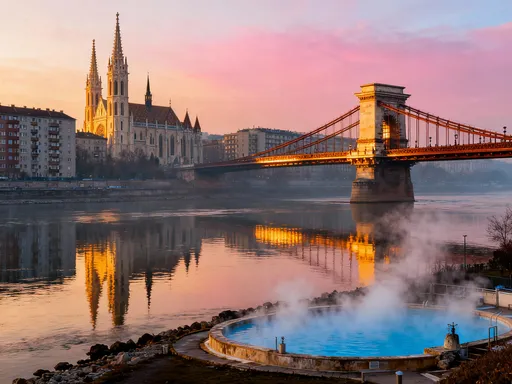
Walking across the Chain Bridge at sunset offers one of the most powerful vantage points in Europe. To the west, the Buda Castle complex glows in warm stone, its turrets and terraces silhouetted against the fading sky. To the east, the Hungarian Parliament Building—neoclassical in form, Gothic in detail—rises with symmetrical grace, its dome mirrored perfectly in the river below. This reflection is more than visual; it is symbolic. The water captures not just the image of the city, but its layered soul. The contrast between Buda’s vertical intimacy and Pest’s horizontal grandeur tells a story of convergence—of two cities officially united in 1873, yet still preserving their unique architectural voices.
The Danube also serves as a timeline. Along its banks, you can trace the evolution of architectural styles in near-chronological order. Roman ruins near the base of Gellért Hill whisper of ancient occupation. Medieval foundations peek through modern plazas. The 18th-century Baroque churches stand beside 20th-century socialist blocks. Even the bridges themselves—each with its own design and history—act as architectural bookmarks. The Elisabeth Bridge, rebuilt in the 1960s with a sleek steel arch, contrasts sharply with the ornate ironwork of the original 1849 Chain Bridge. These structures are not just functional; they are statements of intent, reflecting the values and capabilities of their eras.
For visitors, the river offers both orientation and revelation. A daytime cruise reveals the density and diversity of riverside architecture, while a nighttime walk exposes the city’s romantic glow—golden floodlights illuminating facades, reflections shimmering on black water. The Danube does not merely separate; it connects. It allows the traveler to move seamlessly between centuries, between styles, between worlds—all within a few kilometers. This is the first lesson of Budapest’s architecture: that beauty thrives not in isolation, but in dialogue.
Buda’s Historic Heart: Castles and Churches
Buda’s architectural charm lies in its elevation—both literal and symbolic. Perched on rolling hills, its buildings seem to reach toward the sky, as if aspiring to something beyond the earthly. The Buda Castle complex, dominating the summit of Castle Hill, is the most visible expression of this ambition. Though heavily damaged during World War II and later reconstructed in a simplified form, the castle retains its original scale and commanding presence. Its blend of Baroque and Neoclassical elements reflects the changing tastes of the Habsburg monarchy, while its position overlooking the Danube speaks to centuries of strategic importance. Today, it houses the Hungarian National Gallery and the Budapest History Museum, making it not just a relic, but a living cultural center.
Just steps away, Matthias Church stands as a testament to spiritual and artistic endurance. Originally built in the 13th century, it has been rebuilt, expanded, and restored multiple times, absorbing Gothic, Romanesque, and later Art Nouveau influences. Its most striking feature—the kaleidoscopic roof of green, red, and blue Zsolnay tiles—was added during a major renovation in the late 19th century by architect Frigyes Schulek. The tiles, produced in Pécs, are not only visually stunning but also durable, resistant to weather and pollution. Inside, the church is equally rich: frescoes, carved pews, and a sense of quiet reverence fill the space. It was here that King Matthias Corvinus held court and where royal weddings and coronations once took place.
Adjacent to the church, the Fisherman’s Bastion offers a different kind of experience—one of constructed fantasy and panoramic beauty. Built in the early 20th century as part of the millennium celebrations, it was designed to resemble a medieval fortress, though it never served a military function. Seven turrets represent the seven Magyar tribes that founded Hungary. The bastion’s terraces provide some of the best views in the city, particularly at dawn, when the mist rises from the river and the lights of Pest flicker like stars. Its white stone arcades and carved balustrades create a dreamlike atmosphere, blending historical inspiration with romantic imagination.
These sites are more than tourist attractions. They are emotional anchors—places where history feels immediate and personal. Walking through the cobblestone streets of the Castle District, one can almost hear the echo of horse-drawn carriages, the murmur of courtiers, the chime of church bells. The architecture here is not merely preserved; it is inhabited. Residents live in centuries-old townhouses, cafes operate in vaulted cellars, and artists display their work in medieval courtyards. This continuity—between past and present, private and public—gives Buda its unique character. It is a place where memory is not confined to museums, but woven into the fabric of daily life.
Pest’s Grandeur: Boulevards and Palaces
If Buda is the soul of the city, Pest is its beating heart—expansive, energetic, and unapologetically grand. Laid out on the flat plains of the Great Hungarian Plain, Pest was transformed in the 19th century into a showcase of modern urban planning and architectural ambition. At the center of this transformation was Andrássy Avenue, a broad, tree-lined boulevard modeled after the grand avenues of Paris and Vienna. Declared a UNESCO World Heritage site in 2002, it stretches from the edge of the city center to the City Park, lined with opulent buildings in Neo-Renaissance, Eclectic, and Hungarian Secession styles. The facades are rich with detail: carved floral motifs, sculpted faces, wrought-iron balconies, and intricate cornices. Each building tells a story of wealth, taste, and national pride.
At the heart of Andrássy Avenue stands the Hungarian State Opera House, a masterpiece of 19th-century theatrical architecture. Designed by Miklós Ybl and completed in 1884, it was intended to rival the opera houses of Milan and Vienna. The exterior is restrained by comparison, but the interior is a symphony of luxury. Gold leaf gilds the ceilings, red velvet drapes the boxes, and crystal chandeliers cast a warm glow over the auditorium. The grand staircase, with its marble steps and ornate railings, is a stage in itself. Even for those who do not attend a performance, a guided tour offers a glimpse into a world of artistic opulence. The building is not frozen in time; it remains a vibrant cultural institution, hosting opera, ballet, and concerts year-round.
But Pest’s architectural splendor is not limited to its main thoroughfares. Venture into the side streets between Andrássy Avenue and the Danube, and you’ll discover hidden courtyards, intimate squares, and residential buildings with surprising elegance. Many of these structures date from the late 1800s to early 1900s, when Budapest was one of the fastest-growing cities in Europe. The courtyards—once used for stables or storage—have been repurposed into quiet oases with cafes, art galleries, and design shops. Their iron gates, often shaped into floral or geometric patterns, open like secrets into another world. Above, the upper floors retain their original window frames, stained glass transoms, and decorative stucco.
This blend of public grandeur and private refinement reveals a city that once saw itself as equal to any European capital. After the Austro-Hungarian Compromise of 1867, Budapest experienced a surge of confidence and investment. The construction of the Parliament Building, the expansion of the tram network, and the development of public baths were all part of a broader vision: to create a modern, hygienic, and beautiful city. The architecture of Pest reflects that vision—not as a copy of Vienna or Paris, but as a confident expression of Hungarian identity. The use of local materials, traditional motifs, and national symbols in building design—such as the Turul bird or the Holy Crown—added layers of meaning to the aesthetic. Even today, walking down these streets, one feels the weight of that historical moment, when a city believed in its own future.
Hidden Layers: Courtyards, Synagogues, and Thermal Baths
Beyond the famous landmarks, Budapest’s architectural soul reveals itself in quieter, more intimate spaces. These are the places where function and beauty merge, where daily life unfolds within structures of enduring design. One of the most distinctive features of Pest’s urban fabric is the inner courtyard—known locally as a háskert or udvar. Found behind street-level facades, these hidden spaces were once industrial or utilitarian, housing workshops, stables, or storage. Over the past few decades, many have been revitalized into cultural and social hubs. Today, they buzz with coffee shops, bookstores, co-working spaces, and pop-up galleries. The architecture remains largely unchanged: brick walls, wooden beams, iron staircases. But the atmosphere has shifted—these are now places of creativity, connection, and calm.
Another hidden gem is the Dohány Street Synagogue, the largest synagogue in Europe and the second-largest in the world. Completed in 1859, it is a stunning example of Moorish Revival architecture, inspired by the Alhambra in Spain. Its twin towers, striped red-and-yellow brickwork, and onion domes make it instantly recognizable. Inside, the sanctuary is vast and richly decorated, with a ceiling painted in deep blue and studded with stars, evoking the night sky. The women’s gallery, supported by slender columns, wraps around three sides. Adjacent to the synagogue is the Jewish Museum and a memorial garden dedicated to Hungarian victims of the Holocaust, including a weeping willow sculpture with names inscribed on its leaves. The complex stands as both a place of worship and a testament to resilience.
Equally significant are the city’s thermal bath complexes, which combine architectural grandeur with therapeutic function. Budapest sits on a network of natural hot springs, and for over two millennia, these waters have drawn people seeking healing and relaxation. The Széchenyi Thermal Bath in City Park is the largest medicinal bath in Europe, with 15 indoor pools and 3 outdoor pools set within a vast Neo-Baroque palace. The building’s symmetrical façade, arched colonnades, and central dome create a sense of order and elegance. Inside, vaulted ceilings and mosaic tiles add to the impression of entering a sacred space. Similarly, the Gellért Baths, housed in the Art Nouveau Gellért Hotel, feature stained glass windows, sculpted columns, and a grand central pool under a glass roof. The steam that rises from the water seems almost spiritual, connecting the present to Roman bathhouses and Ottoman hammams.
These spaces—courtyards, synagogues, baths—are not just architectural curiosities. They are living environments where history is experienced, not just observed. They invite slowness, contemplation, and presence. In a world of fast travel and instant gratification, they offer something rare: the chance to dwell within beauty, to feel the weight of centuries in the curve of a staircase or the pattern of a tile. They remind us that architecture is not only about monuments, but about moments—of rest, of reflection, of community.
The Soviet Legacy: Brutalism and Urban Memory
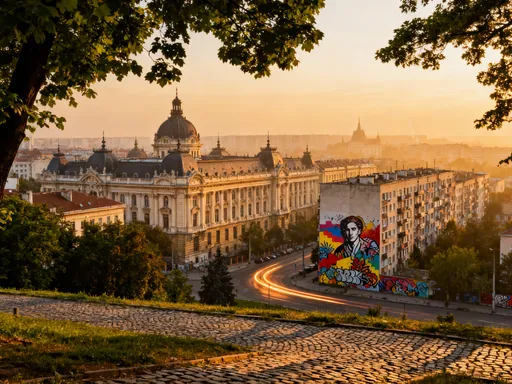
Not all of Budapest’s architecture is ornate or elegant. The city also bears the marks of the 20th century’s most challenging chapter: the Communist era. From 1949 to 1989, Hungary was part of the Eastern Bloc, and its urban landscape was reshaped by socialist ideology and centralized planning. The most visible legacy is Brutalist architecture—massive, functional buildings made of raw concrete, often repetitive in form and scale. The former Trade Union House near Blaha Lujza Square, with its blocky towers and exposed aggregate, is one example. More widespread are the panelház—prefabricated apartment blocks built in the 1960s and 70s to address housing shortages. These neighborhoods, such as those in Újpest or Kőbánya, stretch across the city’s outskirts, housing hundreds of thousands of residents.
At first glance, these structures may seem dull or even oppressive. But they are also part of Budapest’s story—a story of survival, adaptation, and memory. The panelház, for all their uniformity, provided modern amenities—indoor plumbing, central heating, private kitchens—to generations who had previously lived in overcrowded tenements. They represent a promise, however imperfectly fulfilled, of equality and progress. Today, many of these buildings are being upgraded with insulation, new windows, and green roofs. Some communities have added murals, playgrounds, and community gardens, softening the concrete with color and life.
Brutalism, once dismissed, is now gaining appreciation for its boldness and honesty. Architects and preservationists argue that these buildings reflect a particular moment in history—one of industrial ambition, social engineering, and architectural experimentation. The former TV headquarters on Szabadság Bridge, with its dramatic cantilevered design, is now recognized as an engineering feat. Some former administrative buildings have been repurposed into cultural centers, libraries, or tech hubs. This process of reimagining does not erase the past, but integrates it into the present.
Walking through these districts offers a different kind of architectural experience—one of scale, rhythm, and social history. The repetition of windows, the symmetry of courtyards, the sheer size of the complexes create a unique urban rhythm. It is a reminder that architecture is not only about beauty, but about function, ideology, and human need. Budapest does not hide this chapter; it acknowledges it. The city’s ability to hold both the ornate and the austere, the joyful and the somber, is part of what makes it so deeply human.
Modern Twists: Contemporary Design in a Historic Frame
Today, Budapest continues to evolve, balancing the demands of modern life with the responsibility of preservation. New architectural projects are increasingly sensitive to context, aiming not to dominate the skyline, but to converse with it. The extension of the Hungarian National Gallery within Buda Castle, completed in the 2010s, is a case in point. Rather than imposing a bold new form, the design uses subtle materials and low profiles to blend with the historic complex. Similarly, renovations at the Lukács Thermal Bath have introduced modern amenities while preserving the original tile work, layout, and atmosphere.
Adaptive reuse has become a hallmark of contemporary Budapest. Old factories, warehouses, and even a former power station have been transformed into cultural venues. The Müpa Budapest (Palace of Arts), located on the Pest side of the Danube, combines modern glass and steel with acoustic precision, hosting concerts, exhibitions, and film screenings. The Liget Budapest Project, an ongoing initiative in City Park, aims to expand and modernize existing museums while adding new green spaces and pavilions designed by international architects. These interventions are carefully calibrated to respect the park’s historical character while introducing fresh perspectives.
Sustainability is also shaping new designs. Green roofs, solar panels, and energy-efficient systems are becoming standard in both public and private developments. In residential architecture, there is a growing interest in passive houses—buildings that require minimal heating or cooling through superior insulation and ventilation. These innovations do not reject the past; they respond to it, offering solutions for a changing climate and urban lifestyle.
The result is a city that feels both timeless and timely. Modern architecture in Budapest does not shout; it whispers. It does not erase history; it adds to it. This quiet confidence reflects a broader cultural maturity—one that values continuity as much as innovation. In a world where many cities risk becoming generic, Budapest insists on being itself.
How to Explore: A Walker’s Guide to Architectural Discovery
To truly understand Budapest’s architecture, you must walk. No bus tour, no audio guide, no photograph can replace the experience of moving through the city on foot. Start at the Danube and let the river guide you. Cross the Chain Bridge in the early morning, when the light is soft and the crowds are thin. Walk through the Castle District, then descend into the city via the funicular or winding streets. Cross the river again on the Margaret Bridge or the Árpád Bridge, each offering different views. Let your curiosity lead you—not just to the famous sites, but to the in-between spaces.
Pay attention to details. Notice the shape of window pediments, the patterns in iron railings, the texture of stone. Look up—many of the most beautiful elements are above eye level. Observe how light plays on different materials: the warm glow on sandstone, the cool reflection on glass, the shadow patterns cast by balconies. Visit the same street at different times of day; a building that looks plain in daylight may glow at dusk.
Use public transportation to explore beyond the center. Take the M3 metro to Újpest or the H5 suburban line to Csepel to see the full range of architectural styles. In these neighborhoods, you’ll find a different rhythm—one shaped by daily life, not tourism. Talk to locals if you can. A shopkeeper, a tram driver, a gardener may share stories about how a building has changed, or what it meant to their family.
Carry a notebook or camera, but not to document perfectly. Use them to capture moments of surprise: a hidden courtyard, a faded fresco, a child’s drawing taped to a window in a panelház. These are the details that make a city alive. Don’t rush. Architecture reveals itself slowly. Sit on a bench. Have a coffee. Let the city breathe around you.
Conclusion
Budapest’s architecture is more than style—it is memory made visible. Each building, from castle to bathhouse, from synagogue to panel-block, contributes to a story of resilience, creativity, and identity. The city does not hide its scars; it incorporates them. It does not reject the new; it dialogues with it. To walk its streets is to travel through time, not as a spectator, but as a witness. In a world of homogenized cities, where glass towers rise with little regard for context, Budapest stands apart—a place where beauty isn’t imposed, but grown, layer by layer, century by century. Its architecture is not a museum piece, but a living conversation. Let your feet lead you. The city has much to say.